CORE Principles
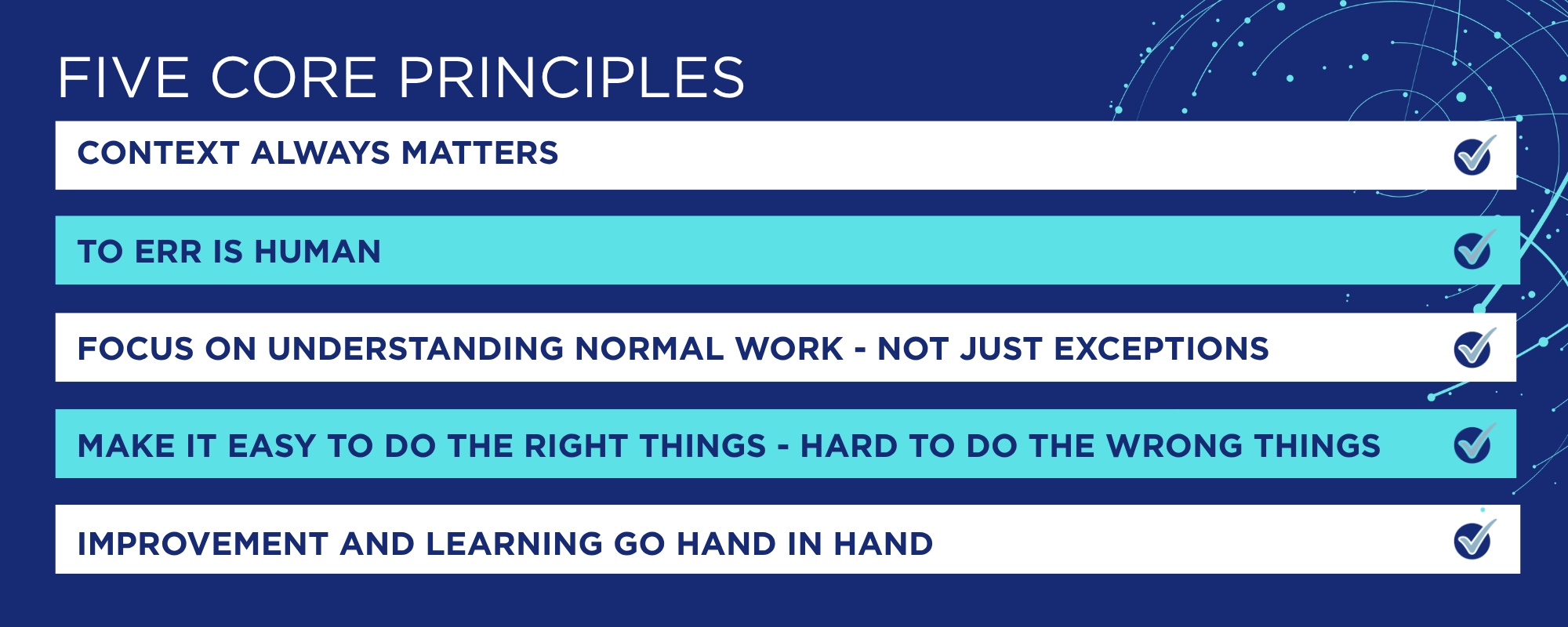
1. Context Always Matters:
Whether we consider good or bad outcomes, they never occur in a complete vacuum. Focusing solely on the person or component that ‘failed’ or ‘underperformed’ or ‘didn’t meet expectations or specifications’ is no guarantee that the outcome will never reappear.
2. To Err is Human:
Mistakes are inevitable because human performance constantly varies under the influence of countless factors (cognitive, sensory, organisational, environmental, etc.), many of which can be far beyond a person’s control or awareness.
3. Focus on understanding normal work, not just exceptions:
To improve safety and productivity, organisations must look beyond formal processes and procedures to understand how personnel truly adapt to real-world operational challenges. By focusing on "work-as-done" (what we actually do) rather than just "work-as-imagined" (what we think/say we do or are going to do) we can bridge the gap between documentation and daily reality to better support successful practices.
4. Make it easy to do the right thing and difficult to do the wrong thing:
Human capabilities and limitations should be front and center when designing processes, procedures, tools, etc. Workplaces should not induce misunderstandings and errors but instead provide enough room for mistakes. Put differently, staff should be able to ‘fail safely’ and learn from their experience so that they ‘fail better’ the next time.
5. Improvement and learning go hand in hand:
To ensure that an operation is safe and remains viable, organisations generally dedicate considerable resources to learn from experience. However, there’s sometimes a missing link between learning and improving, leading to missed opportunities and repeated failures of the same nature. Organisations should therefore actively seek both learning and improving, as the first doesn’t automatically lead to the second.